AI-Based Multilingual Text Extraction
The service accurately extracts text from old, scanned, handwritten, and damaged documents using AI-enabled workflows. It supports mixed-language pages and complex layouts where conventional OCR fails.
Inrec service
Transform Documents into structured editable digital assets ready for search.
Service overview
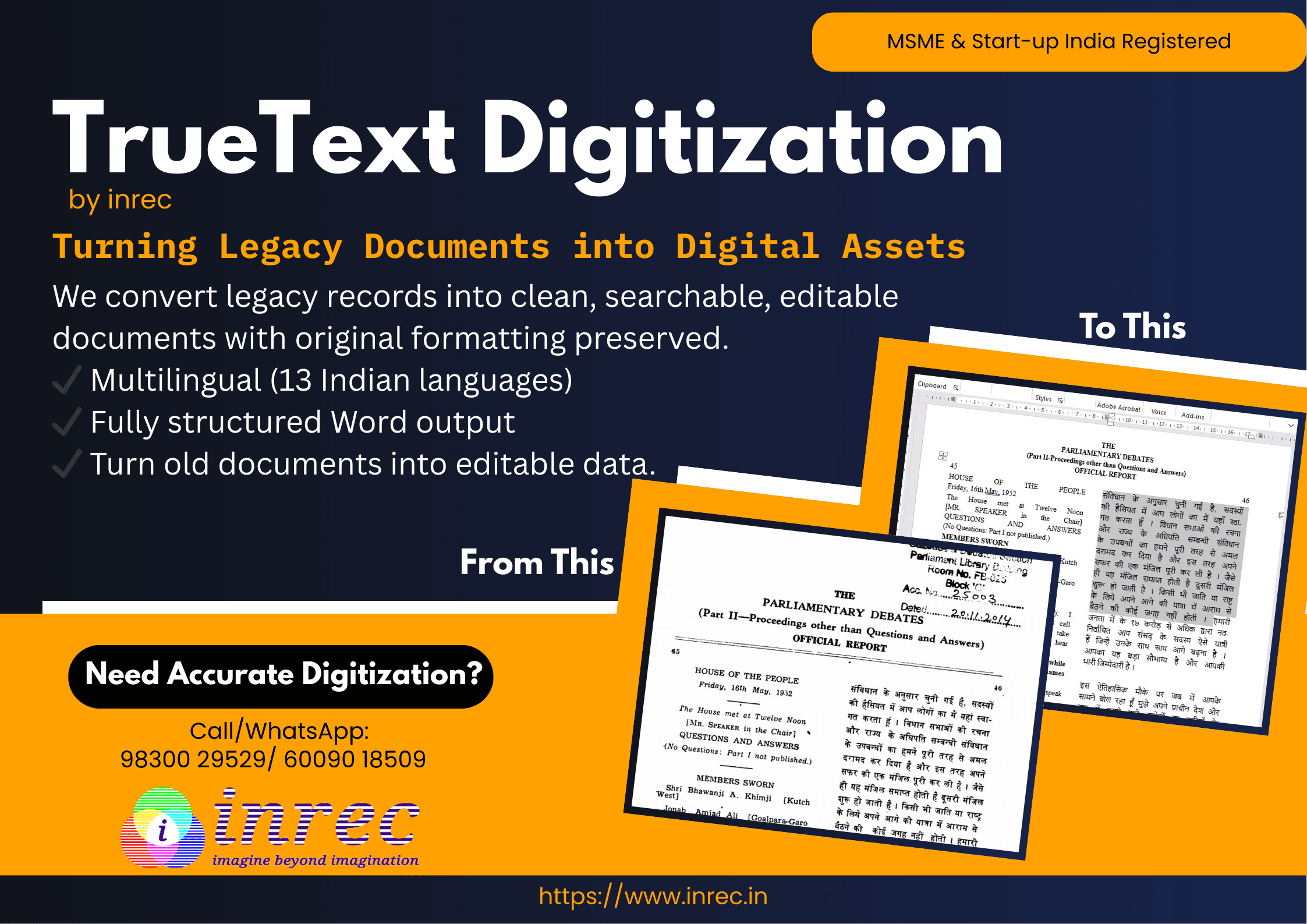
TrueText Digitization is an AI-enabled multilingual document digitization service designed to convert old, scanned, handwritten, and legacy documents into clean, searchable, structured, and fully editable digital formats. Built for government offices, public institutions, enterprises, educational organizations, and legal or archival departments, the service addresses the limitations of conventional OCR systems. Unlike basic text extraction tools, TrueText Digitization focuses on preserving the original document structure, including headings, sections, columns, tables, and logical reading order. By combining AI-based extraction with human-in-the-loop validation by regional language experts, the service ensures high accuracy even for poor-quality, complex, and multilingual documents. The service transforms static paper records and scanned PDFs into usable digital assets that can be archived, searched, integrated with databases, and extended for advanced use cases such as intelligent search, analytics, and document-specific chatbots. TrueText Digitization enables organizations to modernize record systems, reduce manual effort, and unlock long-term value from historical documents without requiring any client-side software or infrastructure.
Service demonstration
The demonstration shows the structured conversion workflow while the supplied overview presents the complete service proposition.
A document transformation story
Follow the real document journey from inaccessible source material to structured, editable and system-ready information.
The challenge
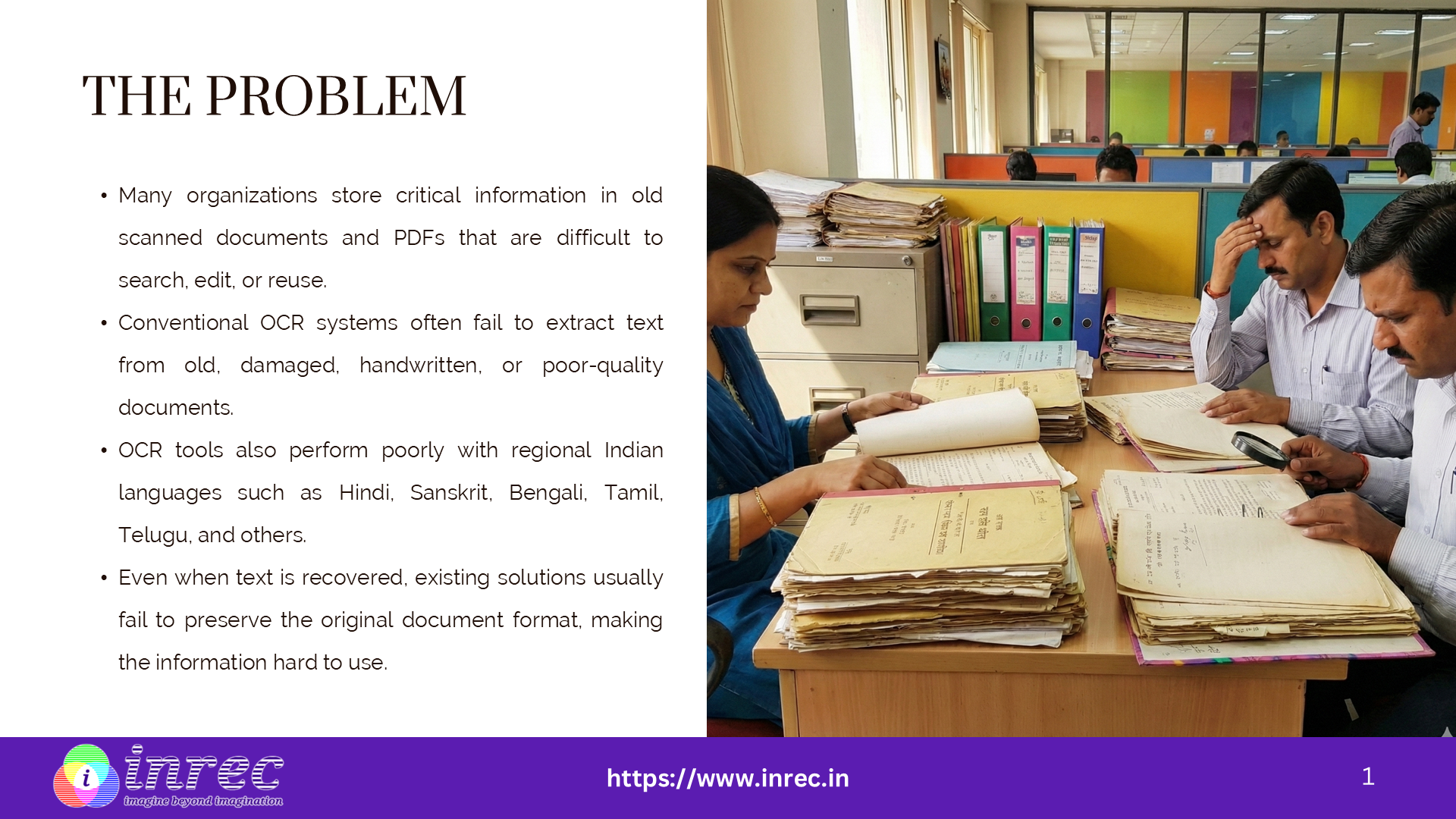
Old files, scanned PDFs, handwritten notes and regional-language records are difficult to search, edit and reuse. Manual review consumes time while valuable information remains inaccessible.
Special features
The service accurately extracts text from old, scanned, handwritten, and damaged documents using AI-enabled workflows. It supports mixed-language pages and complex layouts where conventional OCR fails.
TrueText Digitization handles documents containing Hindi, Sanskrit, Bengali, Tamil, Telugu, and other Indian regional languages, including pages where multiple languages appear together.
Instead of delivering plain text, the service preserves document structure such as headings, subheadings, sections, columns, tables, and spacing, ensuring the digitized output mirrors the original document layout.
Converted documents are delivered in fully editable formats such as Word or structured digital files, allowing easy search, editing, copying, and reuse.
Each extracted page or section can be mapped back to the exact location in the original scanned document, enabling traceability and verification.
Regional language experts review and validate extracted content to ensure accuracy, especially for handwritten text, degraded scans, and language-sensitive records.
The service is designed to handle large-scale archival projects involving thousands or millions of pages, making it suitable for long-term digitization initiatives.
Sensitive and confidential documents are handled securely, with controlled access, audit trails, and compliance-ready processes.
Alongside Indian regional-language workflows, TrueText supports a broad international language set for global archives, multilingual collections, and mixed-language records.
International language coverage
In addition to its Indian-language capabilities, TrueText can process documents across the following international languages. Mixed-language and complex archival records can be combined with human validation according to project requirements.
Core capabilities
Start a conversation
Tell us what you need for TrueText Digitization. We will respond with the right technical and implementation guidance.